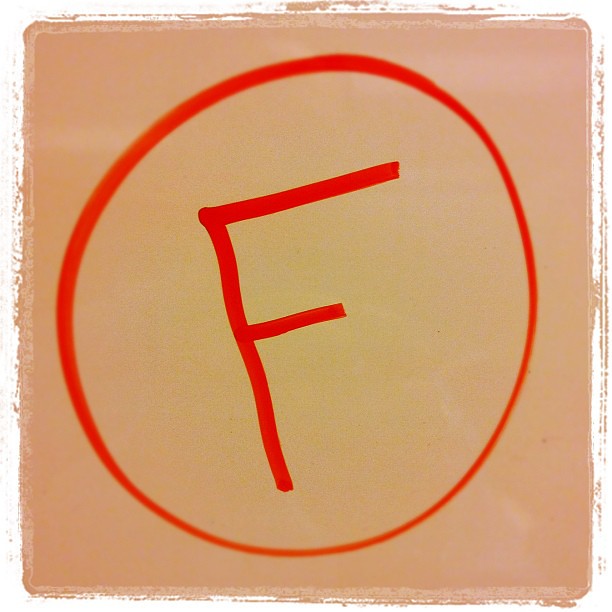
Two years ago I stopped failing students' work. Ever.
This is not school policy, though several of my colleagues' courses work similarly.
All our students do get graded, and this policy surely skews the curve.
I think it's one of the best things I've ever done for my students.
Allow me to explain my basic philosophy here:
- Failure means that the student has not demonstrated desired skills and/or understandings.
- It's my job to help students develop desired skills and understandings. And it's the students' job to develop and demonstrate them, with my guidance.
- If a student fails, neither of us has finished the job.
I believe failing a student and moving forward lets us both off the hook. That's not how the world works, and I don't believe it's how school should work. If we really value these skills and understandings like we say we do, we should hold ourselves and every one of our students accountable for developing them.
- A corollary: I don't believe it is my job to rank students based on their ability to get it right the first time.
I suppose that's the most controversial stance in all this. You might wonder:
But what about the transcript? How will colleges know which students to admit? And isn't it worth something to get it right the first time?
I think our college counselors would agree that we have to represent our students as much more than just their grades, and that any worthwhile college needs a qualitative system for assessing applications. And that ability to get it right the first time? Chances are that student will spend the rest of her life being rewarded for it; I don't see why I have to codify the reward in her education.
Enough with the philosophy. How does it work when a student actually has failed an assessment?
Well, I haven't nailed this down to a science (note this post's label: "experimenting"), but depending on the assessment type, I usually take one of two approaches:
- Essays can always be redrafted. And redrafted. And redrafted. If a draft is not yet passing, I normally won't even give it a grade. I'll require a meeting, we'll go through the rubric together, and we'll make a plan for revising. When the student finally turns in a piece that meets expectations, she earns the grade that draft merits. Note: I never grade first drafts, and at present I allow all students--even those who've passed--the opportunity to redraft until they've achieved success as they define it (or until I assign the next essay).
- Quizzes and tests on which there are definite right and wrong answers require a different approach. It starts the same, though: with a one-on-one meeting. We'll take this time to discuss what happened, to review the wrong answers, and to reinforce lessons that appear not to have hit home. Naturally this sometimes takes additional meetings. Then my approach is usually to write up an alternate assessment.
All the while, I go on teaching new material to the rest of the class, and the student remains responsible for the new material while still working on the previous unit. That's demanding on the student and on me. But it's better than letting either of us off the hook.
A few acknowledgements:
- I work in a privileged setting: all our students are screened through a competitive application process, and two-thirds of my students have previously demonstrated enough success to qualify for Advanced Placement. And the privileges surely go deeper.
- I've never had a student fail a quiz or test retake, and I'm not sure how I'd respond if that happened.
- This is not a panacea. There is plenty of room for my grading policy to improve.
Like most teachers, I hate grades. But we can still use them creatively, and we must.