Showing posts with label reflection. Show all posts

Wednesday, February 18, 2015

Connectivist Learning for All!

This post originally appeared on Klingspace on 8/11/2014:

Kudos to Leslie McBeth on her recent post, “Klingenstein Summer Institute as a Model for Networked Learning.” It came in the midst of a summer when I’ve been thinking intensely about networked learning--for adults, as I prepare faculty professional development, but also for students. It’s always nice to learn that someone else is thinking on the same issues! (I suppose that’s largely the point of networked learning!)

Two giants in this arena are George Siemens and Stephen Downes. Downes writes the newsletter Online Learning Daily, and if you’ve got some extra time on your hands, you can read his 612 pages of collected essays on Connectivism and Connective Knowledge (no doubt he’s written much more in the two years since he published that collection). I highly recommend Siemens’ “Connectivism: A Learning Theory for the Digital Age,” as a primer on networked learning and its aptness for this information age. I recently tweeted out his Principles of Connectivism from that essay:


Together, Siemens and Downes are credited with inventing the MOOC, though CCK08 and the connectivist MOOCs (cMOOCs) they’ve taught since looked very little like today’s high production-value, often low connection-value exponential MOOC (xMOOC) offerings from providers like Coursera.

cMOOCs are Connectivism and networked learning fully realized. As they run, they leverage their scale to de-emphasize the instructor and highlight instead student-student interactions that ultimately build the lessons of the course. But because they run completely in the open, utilizing public social media platforms rather than in a closed Learning Management System, though the course may end, the class never really disbands. The network of learners remains, right in the same social media space(s) where it began, to continue learning on the course’s topic or new interests that find in common. 
Picture
From Hollands, F. and Tirthali, D. (2014). MOOCs: Expectations and Reality
What could these principles look like in a K-12 setting? Inspired by CCK08, Wendy Drexler provides a powerful vision in her video, “The Networked Student”:

One of the most exciting possibilities here is empowering students to engage in networked learning not only with other students, but with learners (and experts) of all ages. Furthermore, while students are still in school, a Connectivist approach practices them in the true habits of lifelong, self-directed learning.

Thursday, February 12, 2015

Takeaways from #NEIT15 - Post 2 - On Defining Digital Literacy (and the need for vision in EdTech)

A couple weeks back at the New York State Association of Independent Schools' Education and Information Technology Conference (#NEIT15), I convened an unconference session on "Defining Digital Literacy" and attended another on "Digital Fluency & its Place in the Curriculum."  At both sessions, we agreed passionately on the importance of developing digital literacy in our students, and we talked specifically about what we already do toward those ends, but the nature of those ends and their scope were never clear. Since nearly a year ago when I accepted my new title, "Director of Digital Literacy and Innovation," I've been trying to wrap my head around this problem.


Why is defining digital literacy so difficult?


First, digital literacy feels like a moving target. Given the rapid pace of technological innovation, how could I possibly know what digital literacy will mean for our Pre-Kindergarteners when they graduate in 2028?

Confounding terms for Digital Literacy
Second and more importantly, we've put practice before vision. The agreed upon imperative to impart digital literacy has fueled a rush to teach it before we've understood it. Just look at the explosion of digital literacy curricula in schools from every sector, and the explosion of information from sources like CommonSense Media, Edutopia, and TeachThought on what those curricula should look like. Don't forget the explosion of confounding terms that researchers, journalists, and practitioners use to describe digital literacy or components of it: not only digital literacy, but also information literacy, media literacy, new media literacy, web literacy, digital citizenship, digital fluency, Internet Safety, and I'm sure others. Compare this abundance with how few frameworks of standards or competencies for digital literacy have taken hold.

With regard not only to defining digital literacy but also to effectively integrating technology into teaching and learning, putting practice before vision is endemic in educational technology. It is tempting to blame the booming educational technology industry for their part in wrapping old modalities in shiny new packaging and calling it transformative. It's perhaps more more to the point to blame cozy relationships between EdTech marketers, education conference organizers, and educational publishers (including bloggers). Honestly, how many app-slams and top-ten lists of educational apps you absolutely must try right this second! do we need?

Why is defining digital literacy so important?


Because in the end, the onus is on us above all, the EdTech leaders, to be critical consumers of educational technology and media. To make those evaluations, we need frameworks. SAMR is one. I believe that robust definitions of digital literacies are another.

I'm not alone. The New Media Consortium's (NMC's) 2015 Horizon Report on higher education identifies "improving digital literacy" as one of the six foremost challenges to educational innovation in the next five years. The authors contend that digital literacy breeds the agility we need to innovate. But they lament that "Lack of consensus on what comprises digital literacy is impeding many colleges and universities from formulating adequate policies and programs that address this
challenge" (24). "Compounding this issue," they write, "is the notion that digital literacy
encompasses skills that differ for educators and learners, as teaching with technology is inherently different from learning with it.
JISC's Seven Elements of Digital Literacies
Supporting digital literacy will require policies that both address digital fluency training in pre- and in-service teachers, along with the students they teach" (24).

Nonetheless, the NMC optimistically categorizes the challenge of improving digital as "solvable" (others are categorized as "difficult" or "wicked"). They point, for example, to promising initiatives from JISC in the UK, from Cornell University, and from the Massachusetts Department of Education.


I would add to NMC's recommendations the Web Literacy Map from Mozilla's WebMaker program:

Mozilla WebMaker's Web Literacy Map


This work is essential because vision is essential. Because vision inspires, lending intrinsic motivation to our imperatives, and vision bestows direction, framing our individual efforts on a collective path.

So how do I define digital literacy?


The framework below is heavily indebted to the work of Doug Belshaw, now the Web Literacy lead at WebMaker. 

In his book The Essential Elements of Digital Literacies, which distills his dissertation, Belshaw argues that definitions of digital literacy must be contextualized to a particular culture; it is impossible to define digital literacy for everyone (hence the teachers and students dilemma that NMC raised). He offers eight elements that he believes will be present in just about any definition of digital literacy--the cognitive, critical, confident, civic, cultural, communicative, constructive, and creative elements--but he deliberately leaves their definitions ambiguous, leaving that task for leaders to take up in our own contexts. 

With input from a great many supportive colleagues, I have arrived at the following, submitted now without further comment (except please, please to invite your comments!):


Friday, January 30, 2015

Takeaways from #NEIT15 - Post 1 - On Incredible Librarians and Tech Integrators

I spent the last three days at the New York State Association of Independent Schools' Education and Information Technology Conference (#NEIT15). I'm so thankful to the conference organizers for the thoughtful work they put into choosing keynotes, balancing them with unconference times, and, of course, sending us to the lovely Mohonk Mountain House!

In my next posts, I'll riff on takeaways from the conference. Here's the first:

Librarians and technology integrators are doing incredible work to inspire students and empower teachers. 


Positioned at a nexus between students, teachers, and administrators, they are the consummate collaborators, constantly envisioning and enacting possibilities for others' work.

One of our keynotes, Shannon McClintock Miller, embodied that role. From her post in the library at the Van Meter Community School, Miller helped to advance teachers' practices, to tap into students' passions, and to lead an effort to develop an innovative K-12 Digital Citizenship, Technology, and Library Science Curriculum for her whole district. All the while, by sharing out her practices, she has inspired countless others to leverage their positions similarly nationwide. Miller and so many conference attendees I met are models of connective, collaborative action, achieving more--seemingly, all at once--than I might ever think possible had I not seen it.

All this sounds great, right? But it does raise the following questions for me:

Whence comes this extraordinary energy, this incredible capacity for action, not just from Miller but from an entire corps of librarians and technology integrators? How can we unleash it where we haven't yet, and feed it where we have?

Also, are circumstances somehow mandating these superhuman performances? Are we supporting these professionals enough? Are we hiring enough of them? Where should we draw the lines between specialists' responsibilities and core teachers'? Should we be worried about burnout? 


Tuesday, June 24, 2014

Facing Up to Structural Inequality: A Justification and a Reading List

This post originally appeared on Klingspace. Join the conversation there!

Lest we needed any more reminders of the importance of facing up in schools to controversies of equity and difference, MTV’s “Look Different” campaign recently released findings from a study “designed to understand and measure how young people are experiencing, affected by, and responding to issues associated with bias.” You might have read about it in this article from Slate, “Why Do Millennials Not Understand Racism?”

The study suggests millennials want to believe it’s possible at once to be both colorblind and attuned to differences of culture and experience. According to the study, “73% [of American millennials] believe never considering race would improve society,” while “81% believe embracing diversity and celebrating differences between the races would improve society.” Somewhere in those results, a large majority of respondents evidently don’t see how those statements conflict.

But I won’t engage here in the millennial bashing that, as Frank Bruni recently wrote, is uncomfortably in vogue in popular media of late. (By most definitions I’ve seen, I myself am a millennial.) Rather, I wish to remind myself and an audience of educators that our students’ misunderstandings are our responsibility.

The failure is ours. We’ve failed so far to teach that difference is about more than the holidays we celebrate and the ways our grandparents spice their food. We’ve failed so far to cast light on structural inequalities that persist despite our national progress over the past half century, despite our having elected a black president.

Inequality is not just “in the eyes of the beholder.” It is reality. It exists in the law, past and present. It exists in our schools, public and private. And it exists in the microaggressions that people of color encounter daily because yes, it exists in the eyes of those that levy those microagressions-- often (but not always) in entirely subconscious cultural biases learned from previous generations, from stereotyped depictions in popular media, and from each other.

Facing up to structural inequality can feel like perilous work in schools. We wonder, how can we expose it and not threaten civility in our own precious communities?

I don’t claim to have the answer. But for all the failures of our popular culture to address inequality courageously and civilly, some are managing both (see list at bottom). I rely on them to model the courage it takes to face up to inequality, and just as importantly, to remind me of inequalities of which I could otherwise go through life blissfully unaware. I have a long way to go in my own education about inequality and how to address it in schools, but I’m thankful for their influence.

For models, see Peggy McIntosh (and The National SEED Project), Jose Vilson, NPR’s Code Switch, and especially Ta-Nehesi Coates whose recent “Case for Reparations” could help restore some stunning omissions from typical high school American History curricula.

What would you add to this reading list?

Thursday, June 5, 2014

Could Your School Use a Skunkworks to Drive Innovation?

This post originally appeared on Klingspace, a new pilot from the Klingenstein Center for Independent School Leadership. Join the conversation there!

Last week, in an #isedchat about overcoming barriers to innovation, Mark Crotty suggested setting up skunkworks:
Wikipedia defines a skunkworks as “a small and loosely structured group of people who research and develop a project primarily for the sake of radical innovation.” According to The Economist, the term originated during WWII at Lockheed as a name for the secret team “removed from the corporate bureaucracy and encouraged to to ignore standard procedures in the hope that they would come up . . . with a high-speed fighter plane that could compete with those produced in Germany.”

Could your school use a skunkworks? Here’s what strikes me as powerful about the concept:
Lockheed's Skunkworks Logo

Skunkworks are collaborative

Working in teams distributes learning, problem-solving, and accountability. Enough said.

Skunkworks are nimble

By operating outside existing structures, skunkworks encourage innovative thinking that might not survive otherwise. Furthermore, skunkworks innovations don’t need buy-in across the entire organization in order to earn a trial; they can actually generate buy-in during a trial.

Skunkworks are bottom-up

School leaders aren’t going to effect lasting change by pounding it down onto the heads of colleagues. A skunkworks begins with leadership’s vision, but operates through the ideas of individuals on the ground, cultivating innovative mindsets, shared responsibility, and institutional pride.


How should your skunkworks work?

Have you tried Design Thinking? It’s not just for students.

A skunkworks can’t fear failure. Consider Google X, the skunkworks with which the search-giant trusts its moonshot thinking. “Failure is not precisely the goal at Google X, writes Fast Company’s Jon Gertner. “But in many respects it is the means.”

Each new idea goes before a Rapid Evaluation Team whose essential task is to naysay. Maybe the idea’s not possible; maybe it’s just not worthwhile. (In a school setting, maybe it’s inappropriate cognitively, developmentally, etc.). If the idea survives, it proceeds to prototyping. If not, “‘When we let it go, it's a positive thing,’" says Rich Devaul, the head of Rapid Eval (quoted in Gertner). "‘We're saying, 'This is great: Now we get to work on other things.'"

By balancing moonshot thinking with Rapid Eval, writes Gertner, “Google X tries hard to remain on the practical side of crazy.”

Who should be on your skunkworks?
As a company, Google deeply values research expertise. But the skunkworks at Google X relies on a different kind of expertise:

‘The classic definition of an expert is someone who knows more and more about less and less until they know everything about nothing,’ says DeVaul [quoted in Gertner]. . . . ‘What we want, in a sense, are people who know less and less about more and more.’

These sound to me like the networked thinkers Steve Valentine describes as essential to innovative teams: “In addition to finding solutions to problems,” he writes, “being networked encourages a mindset of inquiry, which in turn prepares one to make connections and see possibilities in one's work. . . . Someone on your team has to be exhilarated, always, by what’s possible.”

What should your skunkworks work on?
At King, we’re dedicated to creating the next generation of personalized teaching and learning. What are the unique mission and vision at your school? Innovation has to start there.

Though the first two criteria for Google X moonshot ideas (must affect billions; must resemble science fiction) may be grander than what we need, the last is instructive: “any Google X idea that hinges on some kind of new development in material science cannot proceed.”

Education has its sciences too: cognitive, developmental, behavioral, etc. Our skunkworks may not need narrowly focused research experts, but neither can they ignore data and research, which set measures and frameworks for responsible innovation. Our missions are not-for-profit, and our products are not technology; students’ futures lie in the balance.

Is anyone doing this right now?
Keep an eye on the Andover Institute, at Phillips Academy. For our Klingenstein PSL capstone project this year, a colleague and I had the privilege to shadow Head of School John Palfrey, no stranger to tech-sector innovation, who clued us in to this part of their emerging strategic plan. My favorite part? Fellowships granting faculty members time to innovate. 

Friday, May 23, 2014

Treating Students, Too, as Human Resources

This post originally appeared on Klingspace, a new pilot from the Klingenstein Center for Independent School Leadership. Join the conversation there!

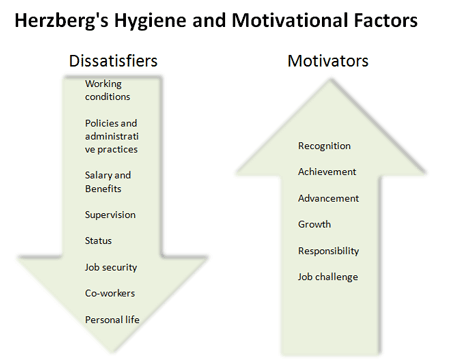
According to the Human Resource Frame of management, optimally productive organizations align their business needs with employees’ individual needs, motivating employees to devote their utmost talent and energy to the enterprise.

HR theory rests on concepts like Maslow’s Hierarchy of Needs and Herzberg’s Two-Factor Theory. I found Herzberg’s theory particularly compelling. It asserts that “hygiene factors” like adequate salary, policy, and working conditions--all of them extrinsic to the job itself--suffice only to stem workers’ dissatisfaction. Genuine satisfaction requires intrinsic “motivators”: achievement, advancement, responsibility, growth, etc. (Of course, the particulars needed to fulfill hygiene factors and motivators will differ across groups and individuals.)


Our cohort studied the HR Frame by considering what motivates people, anticipating the effects of generational changes in the workforce, and examining the experiences of people from underrepresented groups in private school leadership. As a model for HR management, we repeatedly turned to Google’s “People Operations”.

We considered which Structural aspects of our schools might actually stand in the way of motivation and innovation, and we imagined how we might organize schools differently to maximize teachers’ autonomy, mastery, and purpose. We even took a stab at teacher compensation.

But returning to the literature this spring, it struck me: in schools, our students are “human resources” too. How can we better align with students’ needs?

As an experiment, I read back through the HR chapters in Bolman & Deal’s Reframing Organizations, mentally substituting “student” for each instance of “employee” or “worker.” You know what was most enlightening? Try that substitution with the following sentence: “Treated like children, employees behave accordingly” (p. 150). The HR literature repeatedly derides Structural innovations that treat employees like children. So could HR theory suggest that we shouldn’t treat students like children, either?

I don’t mean to suggest that we should pay students, nor that we should ignore developmental perspectives demonstrating how children differ from adults. But the same motivation science underpinning the Human Resource Frame raises questions about how we approach our students:

  1. The HR Frame obviously challenges Structural reforms like ostensibly “teacher-proof” curricula for affording no intrinsic motivation. Doesn’t extending the HR logic nullify rigid, “student-proof” standardization as well?

  1. The HR Frame promotes empowering employees by fostering participation. So how much voice and choice do we afford students in determining how our schools conduct business? Do all students get a voice, or do only a few elected leaders? And where do we draw the lines for what’s up for discussion and what’s not?

Bolman and Deal cite “managers’ ambivalence” as a chief reason why efforts at fostering participation often fail: “. . . [They] like the idea but fear subordinates will abuse it. Without realizing it, managers mandate participation in a controlling, top-down fashion, sending mixed messages, ‘You make the decision, but do what I want’” (p. 152).

Faculty are managers to our students. Are we ambivalent, or are we ready to foster genuine student participation? A wide body of evidence suggests we ought to.

Wednesday, May 21, 2014

What I Hope to Take from (and put into!) #DCMOOC

Over the next few weeks I'm participating in #DCMOOC, a connectivist MOOC about Digital Citizenship taught by Alec Couros. Probably my biggest goal is to really experience what a connectivist MOOC can be, as it's a new concept to me. As I begin a new role at my school as Director of Digital Literacy and Innovation, I also look forward to looking at Digital Citizenship as one of the digital literacies that I teach, and considering how I can enlighten my students and while respecting them and their online practices. I was deeply impacted recently by reading dana boyd's It's Complicated, where I was first struck that notion of truly respecting students' online practices (while also helping students to improve them).

Though I'm new to the connectivist MOOC concept, I understand that whatever I take from the course will rely on what I put in, so my goal is to be active here on my blog, in the Twitter chats when I can make them, and in the sessions each week. I just yesterday graduated from the year-long MA program I was pursuing at Columbia, so I should have the time to dig in!

Thursday, May 30, 2013

Encouraging Risk-Taking by Assessing 'Quality of Failure'

Have you heard yet of Stanford professor Carol Dweck's theory of mindsets? Dweck has identified two basic attitudes people can hold with regard to their own intelligence. According to her website,
In a fixed mindset, people believe their basic qualities, like their intelligence or talent, are simply fixed traits. They spend their time documenting their intelligence or talent instead of developing them. They also believe that talent alone creates success—without effort. They’re wrong.
On the other hand, 
In a growth mindset, people believe that their most basic abilities can be developed through dedication and hard work—brains and talent are just the starting point. This view creates a love of learning and a resilience that is essential for great accomplishment. Virtually all great people have had these qualities.
Dweck's 2006 book Mindset has become one of the seminal texts for teacher professional development. She, Alfie Kohn, and Tony Wagner are a few leading voices in the growing chorus who suggest that our traditional methods of assessment may actually impede the learning we want to inspire. In a 21st Century economy that prizes innovation more than ever, our schools may actually be breeding fixed mindsets.  

The truth is, constructing our own understanding requires making mistakes. 

"Mistakes are not just opportunities for learning," writes philosopher Daniel Dennett; "they are, in an important sense, the only opportunity for learning or making something truly new." Dennett suggests that mistakes drive learning in almost same way mutation drives evolution--a progressive trend that requires plenty of failures. He offers sage advice for how to capitalize on mistakes:
The chief trick to making good mistakes is not to hide them — especially not from yourself. Instead of turning away in denial when you make a mistake, you should become a connoisseur of your own mistakes, turning them over in your mind as if they were works of art, which in a way they are. … The trick is to take advantage of the particular details of the mess you’ve made, so that your next attempt will be informed by it and not just another blind stab in the dark. . . 
So when you make a mistake, you should learn to take a deep breath, grit your teeth, and then examine your own recollections of the mistake as ruthlessly and as dispassionately as you can manage. It’s not easy. The natural human reaction to making a mistake is embarrassment and anger (we are never angrier than when we are angry at ourselves), and you have to work hard to overcome these emotional reactions. Try to acquire the weird practice of savoring your mistakes, delighting in uncovering the strange quirks that led you astray. Then, once you have sucked out all the goodness to be gained from having made them, you can cheerfully set them behind you, and go on to the next big opportunity. But that is not enough: you should actively seek out opportunities to make grand mistakes, just so you can then recover from them.
Here's the problem: traditional assessment penalizes mistakes. To earn an "A," you've got to be right 93% of the time; your failure rate can be no higher than 7%. Alternatively, Tony Wagner often cites an interview with Mark Chandler, senior vice president and general counsel at Cisco: 
I say to my employees, if you try five things and get all five of them right, you may be failing. If you try 10 things, and get eight of them right, you're a hero. You'll never be blamed for failing to reach a stretch goal, but you will be blamed for not trying.
It's clear our schools are not yet on board with this thinking. So what would it look like if we were?

As a Middlebury grad, it pains me to see good ideas coming out of Williams College. But that's where Edward Burger teaches Mathematics, in courses that include a "quality of failure" grade

Burger takes issue with the traditional content-delivery model that "[jumps] over the requisite missteps that originally led to the discovery at hand." If we're not careful, we obscure the record of failures that preceded major contributions to human knowledge, deify those who achieved them, and mystify the process of innovation. 

"In reality," Burger writes, much like Dennett, "every idea from every discipline is a human idea that comes from a natural, thoughtful, and (ideally) unending journey in which thinkers deeply understand the current state of knowledge, take a tiny step in a new direction, almost immediately hit a dead end, learn from that misstep, and, through iteration, inevitably move forward."

"But how do we foster such a critical habit of mind in our students?" he asks. "Answer: Just assess it." 

In Burger's courses, five percent of every student's grade assesses their quality of failure: the risks they attempted, and the falls they took, on their way toward constructing understanding. Burger introduces the risk-taking ideal from the beginning of the course, reinforces it throughout, and at the end, asks students to write a one-page essay reflecting on when they failed and how successfully they learned from it. The students assign themselves a grade from 1-10, and most often, Burger "award[s] them the surprisingly honest and restrained grades they gave themselves." 

I am completely taken with this idea, and look forward to trying it out in my own classes. 

What would it look like in an English class?

I think English students should be failing regularly in two course components: their writing, and their analysis.

The closest I get right now to assessing failure is by assessing how substantially a second draft has improved from the first. A first draft is never perfect, and perfection should never be the goal. By commenting on but not grading first drafts, I hope to encourage risk-taking in voice, argumentation, and analysis (and by refusing to comment on first drafts that don't meet basic expectations, I hope to discourage sloppiness; that's a battle, to be sure). By assessing on my rubric how substantially the new draft has developed, I hope to encourage students to carry their failures forward into lessons.

On a daily basis, as well, students should be risking half-baked, emerging analyses. Some won't be tenable. But discussion should be a collaborative exercise in pursuing analyses to the point where they sink or swim, and developing the swimmers into arguments. Students should pursue the same process individually as they plan their essays; I teach a "Scientific Method" of pre-writing, and perhaps there's a way of assessing the hypotheses that a student discarded on the way to her thesis. 

The two keys to Burger's approach seem to be reinforcing risk-taking over the course of the term, and the assigning a reflective self-assessment at the end. Ending my courses in the past, I've asked students to reflect on their intellectual risk-taking; but as I haven't always reinforced that aim, students often have struggled to recall what risks they took.

I'm excited to move forward in Burger's footsteps, and hopefully cultivate more growth mindsets in my classes. You can expect to see a "quality of failure" grade outlined on my next syllabus.

Monday, May 20, 2013

Bring Discipline Into the Open?

"Praise in public; discipline in private." It's a maxim of teacher preparation. Of course we should call attention to positive models of behavior, and I can see several reasons to discipline in private: among them, to foil negative attention-seeking, to spare the misbehaving student public shame, and in extreme cases to avoid defamation claims.

But I've been reflecting on the social purpose of school discipline:

By disciplining behind the scenes, do we rob school discipline of its broader educative value? 
For this post, I'm mostly interested in disciplinary responses to transgressions of major school rules. 
Behavioral theorist Jacob S. Kounin's work from the mid-20th century on "The Ripple Effect in Discipline" is still cited frequently in professional discussions of school discipline. Kounin posited, unsurprisingly, that "what a teacher does to control children's behavior affects the children who watch as well as the children who are corrected." Without children watching, without transparency, there can be no ripple effect. Does that doom our students to repeat their peers' mistakes? 
Furthermore, by opening up disciplinary processes to scrutiny, transparency can build trust in the processes: trust from victims, who see their wrongs addressed, and trust from the community and even perpetrators themselves, who may see the equitability of disciplinary responses. Such trust is crucial to establishing a feeling of safety in the community. Conversely, a lack of transparency may leave the school open to accusations of bias in its handling of discipline from students, families, and outsiders.

So why wouldn't we bring discipline out of the shadows? Why wouldn't we build community conversation around behavioral transgressions and disciplinary responses?
The Family Educational Rights and Privacy Act (FERPA) governs the privacy of student records, including discipline records. Unfortunately, as Lynn M. Daggett has demonstrated, FERPA can prohibit schools from disseminating disciplinary results. (For those interested, here's general guidance on FERPA from the Department of Education (DOE), and here is a legal memo on compliance from the National Association of Secondary School Principles).  
There is hope yet in independent schools, as the federal law applies only to institutions that accept DOE funding. We might fear defamation and breach-of-contract suits, but the National Association of Independent Schools (NAIS) notes that in handling disciplinary issues, independent schools are bound only to follow their own procedures absolutely. Furthermore, NAIS advises that "truth is a complete defense" against a defamation claim, and that schools can protect against breach-of-contract suits with "explicit language in student handbooks, enrollment contracts, or other school publications" emphasizing that disciplinary records may be disclosed.

What would an ideal disciplinary process look like?

Ideal disciplinary processes lay themselves bare, and they involve the community. I'll offer three exemplars:

At Moses Brown School (full disclosure: I'm an alum, and I have raved about it before), after administrators determine that a major rules infraction has occurred, the transgressing student appears before a Discipline Committee of three students and three faculty. Student members nominate themselves and are elected by the entire school to serve the full academic year. (Occasionally when medical, psychological, or other circumstances require confidentiality, the transgressing student may go to an administrative hearing comprised only of adults.) 
Ahead of each Discipline Committee hearing, a notice is posted publicly with the student's name, the nature of the infraction, and an invitation for letters from the community attesting to the student's character. During the hearing convened by the dean of students, the Committee hears a statement of the facts from the dean and statements from the student, his or her advisor, and/or another character witness, and Committee members read the community letters. In the Quaker tradition, the committee then works toward a consensus recommendation for a disciplinary response. After making their recommendation to the head of upper school, they draft a letter explaining it to the community. That letter is emailed to faculty, who read it aloud to students and facilitate small-group discussion during the next morning's advisory meeting. 
I admire the required consensus, which puts student and faculty Committee members on equal footing, and the transparency, which quashes rumor and encourages informed discussion of the transgression and consequences. 
You can read a full description of Moses Brown's disciplinary procedures in this (old) version of their handbook.

Other schools have adopted even more broadly participatory processes:
At Canterbury School, rather than a permanent committee elected by the school, the Discipline Committee comprises a rotation of every student leader, including dormitory proctors, team captains, etc., and all faculty. They serve according to a weekly schedule assigned at the beginning of the year. If a hearing is called during the week you are assigned, you serve on that committee. Deliberations and decisions, however, are considered confidential. You can read about Canterbury's Discipline Committee on the NAIS website
At Humanities Preparatory Academy, "Fairness Committees" are formed ad-hoc, much like juries are, from the whole school community, including all students, faculty, and office staff. Committee hearings focus on the school's clearly articulated "core values," and seek out "appropriate consequences" rather than mere "punishments."Any community member can call any other into a hearing over a grievance framed in relationship to a core value. Maria Hantzopoulos writes, "Fairness works well at Prep because it is one of many structures that encourages student voice, democratic participation, and integrates the school’s core values, creating a humanizing and dignified environment for young people."  
I admire how these processes involve more than a small handful of students, calling on them to enforce their community's values themselves. These are truly democratic processes which must surely cause ripple effects and inspire trust.  
What about the transgressing students themselves? Does transparent and participatory discipline scapegoat them, benefitting only the community at large?
I'll take up that question in another post.


Suggested further reading:
  • Meyer, Luanna H. and Ian M. Evans, The School Leader's Guide to Restorative Discipline. Thousand Oaks: Corwin, 2012. 


Saturday, May 4, 2013

Teaching Grammar: Individualization, or Direct Instruction?

Grammar instruction these days is in one of those pendulum-shift moments. A couple decades back, we decided the old direct instruction was the enemy: teacher-focused, it just doesn't engage students. Better, we decided, to teach grammar in context: pull lessons from class readings and student essays, and adjust based on the needs of the students. Individualize! (The hot concept we espouse without always knowing what it looks like).

I was a disciple from the start of my career. And remembering the seeming arbitrariness of grammatical principles teachers had handed down unto me--never end a sentence with a preposition; always use the Oxford Comma; never use the Oxford Comma; never, ever use contractions or the passive voice--I stood before my first classes and vowed always to justify the rules I enforced. (To meet that promise, I had to learn a whole lot more about English--and about using auto-text to save me from typing the same explanations on their essays over and over).

And then each year pressed on at light speed, and we delved into wonderful texts, exploring theme, characterization, symbolism, irony, etc., etc. And outside my comments on their essays, grammar never really came up. (I never gave it regularly scheduled programming--another post to come).

And students just kept on mixing up plurals and possessives.

And they just kept on confusing there, their, and they're.

And they just kept on using semicolons in the place of commas, commas in the place of semicolons, and the occasional colon whenever they suspected they'd overused the other two.

And so, in 2013, we're back to direct instruction.

But in a flash today, I wondered: by just pasting the auto-text explanation to the student's essay, challenging him to edit the issue away, and rewarding or penalizing the final draft based on whether or not he had--was I ever thoroughly individualizing?

Couldn't there be an intermediate step, a formative assessment on which he could practice the concept without pressure before applying it on the summative final draft?

So here's a new idea:

For each essay I comment on, as often as possible, I want to assign the student one grammatical or stylistic principle to work on.

For each principle, as before, I want to have collected either my own explanation, or a link to a good one on the web.

But furthermore, for each I want to have at least one exercise I can assign to the student, on which he can practice applying the principle before turning back to his essay. And I want to hold the student accountable for handing in that exercise ahead of the essay deadline, and to use that opportunity to confirm he's actually grasped the lesson.

That, I'm reasonably sure, is individualization. (Finally!)

Tuesday, April 23, 2013

Ethical Education and the Liberal Arts

In "This is Water," an address David Foster Wallace delivered at Kenyon College's 2005 commencement (available here excerpted and as audio; here as abridged text; and here complete for purchase; it is so very worth the read), Wallace argued that a liberal arts education offers not so much lessons in how to think, as the freedom to choose what to think about.

Humankind's "natural default setting," he suggested, is total self-absorption: "Everything in my own immediate experience supports my deep belief that I am the absolute center of the universe; the realest, most vivid and important person in existence." Such thinking can only lead to misery: "If you're automatically sure that you know what reality is, and you are operating on your default setting, then you . . . probably won't consider possibilities that aren't annoying and miserable."

As an alternative, Wallace said, the liberal arts bestow a "most precious" freedom: "attention and awareness and discipline, and being able truly to care about other people and to sacrifice for them over and over in myriad petty, unsexy ways every day."

I remember the teachers who summoned me to think this way, who took time away from rote content to have us confront issues and perspectives far beyond our limited experiences. At the same time, they never trivialized our experience. Rather, they offered us the space and attention to work through our issues--which felt very real to us!--and to explore connections between our experiences and others'.

Perhaps that was easier at Moses Brown, a Friends school with traditions like Meeting for Worship, open community forums, and an "Opinion Board" to which students posted positions on all the major issues of the day. (Invited at a recent alumni event to reflect on the school's traditional values and suggest future priorities, another alumna suggested "ethical leadership" was "granted" as a priority). Oh, what a world! (I despair sometimes when students at my current school get themselves excused from presentations by guest speakers like Tim Wise and Sheryl WuDunn, taking the opportunity for an early weekend; but those failures are ours, not theirs).

How can I--how can we--become like those ethical teachers? How will our liberal arts education live up to Wallace's promise? (And how will it do so at secular schools, within communities predicated at least in part on what Wallace deemed "the so-called real world of men and money and power"?)

It takes committing to ethical education, right alongside skills and content and college preparedness, as a preeminent goal. At secular institutions, we must be especially forthright about that commitment, lest we be accused of covertly proselytizing, and steadfast about it, lest we be accused of paying lip service. (To pay lip service to ethics is perhaps the most damaging behavior we can model). Why not, for instance, put ethical questions on par with essential questions?

It takes affording that commitment time: time away from the traditional skills and content, time for students to confront the real world outside our classrooms, time for self-reflection, for them to see themselves as a part of that real world rather than apart from it. I know myself, and I know if I don't write that time into my curriculum, I'll never find it along the way. Reading a post by John Spencer, I was struck by a class ritual he alluded to called "Philosophical Fridays." Perhaps that's what it takes; perhaps as well we need "Worldly Wednesdays." As true believers in and practitioners of the liberal arts, we have to be able to help students connect such discussions to the skills and content of our courses.

It takes giving our students voice, and agency, and reason to trust that we are listening. We cannot raise adults by infantilizing students. "Education," John Dewey reminds us, ". . . is a process of living, and not preparation for future living." Students need space to try on identities, to take stands, to thrash out their conflicts. That's what those Moses Brown traditions achieved, and though there they were founded on Quaker beliefs in The Light Within and the Inner Voice, such commitments needn't be doctrinal.

"In the day-to day trenches of adult life," Wallace told the Kenyon graduates, "there is actually no such thing as atheism. There is no such thing as not worshipping. Everybody worships. The only choice is what to worship."

To live up to Wallace's promise for the liberal arts, we have to decide what our schools and our courses will worship, and we have to build structures for keeping those objects in focus.

When I began this career, I justified it saying that the students we teach in independent schools, almost irrespective of the choices they make, will end up in positions of power, and that for the sake of our society they had better arrive there with a conscience.

It's a challenge every day not to forget that mission amidst the swirl of metaphor, characterization, and argumentative topic sentences. It's a challenge not to revert to my natural default setting, not to sacrifice the liberal arts' promise on the altars of content and college preparation. It's a challenge worth struggling with.

Sunday, April 14, 2013

Why I'm Leaving for Grad School

Recently I accepted an offer of admission to the MA program in Private School Leadership at the Klingenstein Center, Teachers College, Columbia University. I'll enroll full-time for the 2013-2014 academic year.

This means leaving my beloved position at King, foregoing a year of salary, and taking on debt. It probably means deferring home ownership.

It means wrapping up or setting aside countless projects I'd planned to carry into next year, and giving up the chance that every teacher looks forward to: the chance to teach it, whatever it is, just a little better beginning in the fall.

It means giving up petty things like my school-owned devices. It means resuming an hour-plus commute only a year after ending it--this time, in the opposite direction.

It means a whole lot of uncertainty, when just recently I'd felt pretty certain about the next few years.

...It also means becoming a full-time student again for the first time since undergrad.

It means reading: reading constantly, reading insatiably, reading immediately what I'm told to read, instead of just adding it to a "to-read" pile buried beneath more pressing work.

And writing, of course. How I look forward to a year where the most substantial writing I do isn't in student comments and parent emails!

It means gaining a new cohort of peers from across the country to learn with and learn from; three years on, I'm so thankful for my network of peers from the Klingenstein Summer Institute.

It means new mentors, as well. New inspirations, new models, new advice. I'm thankful for the mentors who helped me choose this path.

It means strapping into the Klingenstein rocket again, yielding to Mission Control, and launching into a year-long exploratory mission to orbits way beyond where my PLN alone can take me.

Surely, it means beaming back glimpses here, and returning with a lifetime's worth of specimens to share.

Ultimately, that's what this decision is about: all I'll bring back. Inspiration, aspirations, momentum. Perspective.

As I decided, some of the best advice I got was this: the best time to make a change is when everything is going right.

This has been the most professionally rewarding year of my life. It's not easy to step aside, but I think it's right.

T-minus five months and counting!

Wednesday, February 27, 2013

Over/under: How much planning is really necessary? Part II: Under

Five years into my career now, I must've passed the 1,000 class mark a while back. I've over-prepared for some, and yea, I've underprepared for plenty. Under-preparing doesn't have to be the end of the world: I pride myself at being good on my feet, and often the best discussions result when I just surrender the reins, zip my mouth, and let the kids hash out meaning themselves. But it's still not a good habit to get into.

I'm guilty of a different kind of under-planning this year, though, and it's a mistake I'll never make again.

The week leading up to the first day of school is so frenetic. There are classrooms and offices to arrange, meetings, meetings, meetings, units to plan, meetings, and to top it all off, there's just a little summer left, so I'm trying to savor late evenings, late mornings, and as much time as possible by the water. This year I was beginning a new position as Technology Coordinator, which meant group trainings, more meetings, and colleagues dropping in with questions just frequently enough to keep me from completing any task of my own so long as I was in the building. (And to my colleagues: I loved every second of it, so please don't stop!!)

As the first day of classes loomed nearer and nearer, I knew I should be thinking about my course outline and expectations. My handouts always had been traditional, describing the course, promoting respect above all, outlining the late policy, the revision policy, etc. I recall thinking I wanted to democratize the expectations: allow the kids to define what it means to be prepared, what our discussion rules would be, when it's appropriate to leave for the bathroom. Sounds great, right?

I'm sure it could have been, had I committed myself to doing it. I could have written it down, devoted some time to it in planning the first few sessions. But in that frenetic week before school started, and through the electrifying first week that followed, I forgot. I just jumped right in to classes, and didn't look back.

That was poor planning.

Successful classroom management begins and ends with clear expectations. This is not a corner to cut. We would have been far better off with undemocratic expectations than we were with unclear ones. Time spent early on to establish expectations and rituals, to build a classroom community, is never time wasted.

Lesson learned.

Monday, February 25, 2013

Over/under: How much planning is really necessary? Part I: Over

It was September 2008. I was fewer than four months out of college, and a night away from beginning the teaching career I'd aspired to for years. I would teach three sections the next day: two of sophomore (Form IV) Humanities, and one of Form V American Literature....And I was going to be prepared.

The sophomore summer reader at this school was just a little book (only a poem, really!): The Aeneid. The juniors had "read" Huckleberry Finn. You know, a couple lightweight texts, no worries about leaving students alone with dense Classical allusion or satire on America's racist past...

I planned every five minutes of those classes: I knew, following a trip through the detailed syllabus, all the questions I'd ask, and everywhere I'd lead the discussion. I bet I even planned my jokes.

And then, of course, the kids hadn't read. Or they hadn't read well. And I adapted, and we all adjusted, and after a few weeks we got to know each other and started to learn.

I taught at that school for two years, and continued to plan heavily--but I'd learned I had to be just as prepared to improvise.


Fast forward two years. New school, new material--this time of my own choosing. I had let go of planning every minute of my classes, but I still knew everything I wanted us to cover and the order I hoped we'd cover it in.

The kids were so enthusiastic. It was going great!

...for me.

After a few weeks I got feedback that the students felt I was stifling them.

And they were right. As always, I'd known where I wanted the conversation to go; and as it turns out, I'd taken all that enthusiasm, that excitement over the vibrant texts we were reading, and I'd tried to wrangle it, to wrestle and shape it toward my ends, regardless of what the students really were thinking and wanted to say. I had them excited, and I was wasting it, because my excitement was more important to me than theirs was.

Fast forward another couple years, to now. Most days, I plan one question, and I give it to students for a blog reflection ahead of class. When it turns out to be the right question--it doesn't always--we spend long enough on it in the first part of discussion to send us in plenty of productive directions for the rest of the period. I can't help but have some ideas of where I'd like things to go, but I'm trying hard to let go of the reins and allow the students to follow their own ideas. On days when it wasn't the right question, I diagnose: where did I lose them? I try to find something that we all did understand, and build from there. This is an act of improvisation. It's harried, it's exhausting; but it's genuine. In that same spirit, I don't bother planning my discussion questions (except the unit's essential questions) weeks ahead of time, because they have to come out of the progress we've made recently, which can't be predicted.

I expect I'll write a great deal more in this space about leading discussion. There's so much more for me to learn! But I've learned for sure it's a waste of time--and worse, a pedagogical sin--to plan too much, and to prioritize the plan over the students' understanding.

Monday, February 18, 2013

Failing Grades: Don't ever let them off the hook


Two years ago I stopped failing students' work. Ever.

This is not school policy, though several of my colleagues' courses work similarly.

All our students do get graded, and this policy surely skews the curve.

I think it's one of the best things I've ever done for my students.


Allow me to explain my basic philosophy here:

  • Failure means that the student has not demonstrated desired skills and/or understandings. 
  • It's my job to help students develop desired skills and understandings. And it's the students' job to develop and demonstrate them, with my guidance. 
  • If a student fails, neither of us has finished the job.
I believe failing a student and moving forward lets us both off the hook. That's not how the world works, and I don't believe it's how school should work. If we really value these skills and understandings like we say we do, we should hold ourselves and every one of our students accountable for developing them.

  • A corollary: I don't believe it is my job to rank students based on their ability to get it right the first time.

I suppose that's the most controversial stance in all this. You might wonder: But what about the transcript? How will colleges know which students to admit? And isn't it worth something to get it right the first time?

I think our college counselors would agree that we have to represent our students as much more than just their grades, and that any worthwhile college needs a qualitative system for assessing applications. And that ability to get it right the first time? Chances are that student will spend the rest of her life being rewarded for it; I don't see why I have to codify the reward in her education.

Enough with the philosophy. How does it work when a student actually has failed an assessment?

Well, I haven't nailed this down to a science (note this post's label: "experimenting"), but depending on the assessment type, I usually take one of two approaches:

  • Essays can always be redrafted. And redrafted. And redrafted. If a draft is not yet passing, I normally won't even give it a grade. I'll require a meeting, we'll go through the rubric together, and we'll make a plan for revising. When the student finally turns in a piece that meets expectations, she earns the grade that draft merits. Note: I never grade first drafts, and at present I allow all students--even those who've passed--the opportunity to redraft until they've achieved success as they define it (or until I assign the next essay). 
  • Quizzes and tests on which there are definite right and wrong answers require a different approach. It starts the same, though: with a one-on-one meeting. We'll take this time to discuss what happened, to review the wrong answers, and to reinforce lessons that appear not to have hit home. Naturally this sometimes takes additional meetings. Then my approach is usually to write up an alternate assessment. 

All the while, I go on teaching new material to the rest of the class, and the student remains responsible for the new material while still working on the previous unit. That's demanding on the student and on me. But it's better than letting either of us off the hook.

A few acknowledgements:

  • I work in a privileged setting: all our students are screened through a competitive application process, and two-thirds of my students have previously demonstrated enough success to qualify for Advanced Placement. And the privileges surely go deeper.
  • I've never had a student fail a quiz or test retake, and I'm not sure how I'd respond if that happened.
  • This is not a panacea. There is plenty of room for my grading policy to improve. 
Like most teachers, I hate grades. But we can still use them creatively, and we must.

Saturday, February 16, 2013

Why blog? It's about pushing yourself


Last week I was fortunate to participate in a site visit to the 1:1 Learning Initiative at Montclair Kimberly Academy. It was one of those professional development days that just sets your head spinning. My hat is off to Bill Stites, Reshan Richards, Erica Budd, and all the others responsible for their hugely thoughtful program. Here are my notes.

A student laptop leadership team. A driver's manual and driver's test for earning admin rights on school-issued machines. An insistance on a maintaining a genuine technology environment in which students have to be responsible, and are allowed to make mistakes. A Global Citizenship course combining global issues, ethics, and information literacy. Evernote integration. And so much more. I was pretty bowled over.

Where does such thoughtfulness come from? Well I can't help but think it has something to do with the amount of sharing and reflection that teachers and administrators at MKA engage in right out in the open. Long before I ever stepped foot on their campus, I knew tons about what they were up to. I'd followed Bill Stites on Twitter and checked in on his blog for a couple years. I'd read Steven J. Valentine's "The Professionalization of Independence" and David Flocco's "Deeper Learning, Reduced Stress," in Independent School Magazine. I'd experimented with Reshan Richards's Explain Everything app.

It can't be a coincidence that all this sharing is coming from one school: MKA's faculty culture clearly encourages it. Reflecting himself on hosting the site visit, Bill said it the best: "Success is about Sharing." I'd add only that success is about deliberate reflection: about forcing oneself to pause and look backward to decide how best to move forward.

So as this blog's title suggests, I'm not here to pretend to be an expert. I'm going to share to push myself, to push my colleagues, and to push my school. Maybe I'll push some of you, like the folks at MKA have pushed me.