This post originally appeared on Klingspace, a new pilot from the Klingenstein Center for Independent School Leadership. Join the conversation there!
According to the Human Resource Frame of management, optimally productive organizations align their business needs with employees’ individual needs, motivating employees to devote their utmost talent and energy to the enterprise.
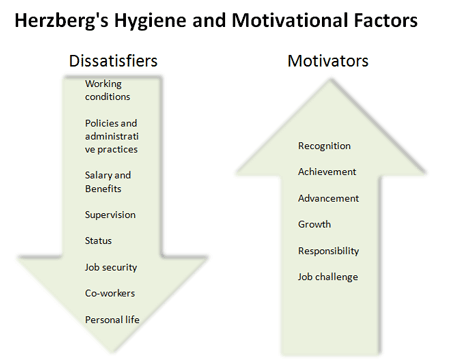
HR theory rests on concepts like Maslow’s Hierarchy of Needs and Herzberg’s Two-Factor Theory. I found Herzberg’s theory particularly compelling. It asserts that “hygiene factors” like adequate salary, policy, and working conditions--all of them extrinsic to the job itself--suffice only to stem workers’ dissatisfaction. Genuine satisfaction requires intrinsic “motivators”: achievement, advancement, responsibility, growth, etc. (Of course, the particulars needed to fulfill hygiene factors and motivators will differ across groups and individuals.)
Our cohort studied the HR Frame by considering what motivates people, anticipating the effects of generational changes in the workforce, and examining the experiences of people from underrepresented groups in private school leadership. As a model for HR management, we repeatedly turned to Google’s “People Operations”.
We considered which Structural aspects of our schools might actually stand in the way of motivation and innovation, and we imagined how we might organize schools differently to maximize teachers’ autonomy, mastery, and purpose. We even took a stab at teacher compensation.
But returning to the literature this spring, it struck me: in schools, our students are “human resources” too. How can we better align with students’ needs?
As an experiment, I read back through the HR chapters in Bolman & Deal’s Reframing Organizations, mentally substituting “student” for each instance of “employee” or “worker.” You know what was most enlightening? Try that substitution with the following sentence: “Treated like children, employees behave accordingly” (p. 150). The HR literature repeatedly derides Structural innovations that treat employees like children. So could HR theory suggest that we shouldn’t treat students like children, either?
I don’t mean to suggest that we should pay students, nor that we should ignore developmental perspectives demonstrating how children differ from adults. But the same motivation science underpinning the Human Resource Frame raises questions about how we approach our students:
- The HR Frame obviously challenges Structural reforms like ostensibly “teacher-proof” curricula for affording no intrinsic motivation. Doesn’t extending the HR logic nullify rigid, “student-proof” standardization as well?
- The HR Frame promotes empowering employees by fostering participation. So how much voice and choice do we afford students in determining how our schools conduct business? Do all students get a voice, or do only a few elected leaders? And where do we draw the lines for what’s up for discussion and what’s not?
Bolman and Deal cite “managers’ ambivalence” as a chief reason why efforts at fostering participation often fail: “. . . [They] like the idea but fear subordinates will abuse it. Without realizing it, managers mandate participation in a controlling, top-down fashion, sending mixed messages, ‘You make the decision, but do what I want’” (p. 152).
Faculty are managers to our students. Are we ambivalent, or are we ready to foster genuine student participation? A wide body of evidence suggests we ought to.