Showing posts with label voice. Show all posts

Friday, May 23, 2014

Treating Students, Too, as Human Resources

This post originally appeared on Klingspace, a new pilot from the Klingenstein Center for Independent School Leadership. Join the conversation there!

According to the Human Resource Frame of management, optimally productive organizations align their business needs with employees’ individual needs, motivating employees to devote their utmost talent and energy to the enterprise.

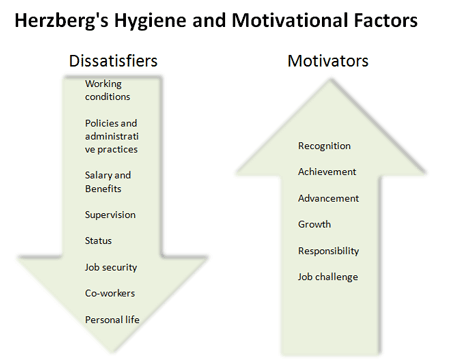
HR theory rests on concepts like Maslow’s Hierarchy of Needs and Herzberg’s Two-Factor Theory. I found Herzberg’s theory particularly compelling. It asserts that “hygiene factors” like adequate salary, policy, and working conditions--all of them extrinsic to the job itself--suffice only to stem workers’ dissatisfaction. Genuine satisfaction requires intrinsic “motivators”: achievement, advancement, responsibility, growth, etc. (Of course, the particulars needed to fulfill hygiene factors and motivators will differ across groups and individuals.)

Our cohort studied the HR Frame by considering what motivates people, anticipating the effects of generational changes in the workforce, and examining the experiences of people from underrepresented groups in private school leadership. As a model for HR management, we repeatedly turned to Google’s “People Operations”.

We considered which Structural aspects of our schools might actually stand in the way of motivation and innovation, and we imagined how we might organize schools differently to maximize teachers’ autonomy, mastery, and purpose. We even took a stab at teacher compensation.

But returning to the literature this spring, it struck me: in schools, our students are “human resources” too. How can we better align with students’ needs?

As an experiment, I read back through the HR chapters in Bolman & Deal’s Reframing Organizations, mentally substituting “student” for each instance of “employee” or “worker.” You know what was most enlightening? Try that substitution with the following sentence: “Treated like children, employees behave accordingly” (p. 150). The HR literature repeatedly derides Structural innovations that treat employees like children. So could HR theory suggest that we shouldn’t treat students like children, either?

I don’t mean to suggest that we should pay students, nor that we should ignore developmental perspectives demonstrating how children differ from adults. But the same motivation science underpinning the Human Resource Frame raises questions about how we approach our students:

  1. The HR Frame obviously challenges Structural reforms like ostensibly “teacher-proof” curricula for affording no intrinsic motivation. Doesn’t extending the HR logic nullify rigid, “student-proof” standardization as well?

  1. The HR Frame promotes empowering employees by fostering participation. So how much voice and choice do we afford students in determining how our schools conduct business? Do all students get a voice, or do only a few elected leaders? And where do we draw the lines for what’s up for discussion and what’s not?

Bolman and Deal cite “managers’ ambivalence” as a chief reason why efforts at fostering participation often fail: “. . . [They] like the idea but fear subordinates will abuse it. Without realizing it, managers mandate participation in a controlling, top-down fashion, sending mixed messages, ‘You make the decision, but do what I want’” (p. 152).

Faculty are managers to our students. Are we ambivalent, or are we ready to foster genuine student participation? A wide body of evidence suggests we ought to.

Tuesday, April 23, 2013

Ethical Education and the Liberal Arts

In "This is Water," an address David Foster Wallace delivered at Kenyon College's 2005 commencement (available here excerpted and as audio; here as abridged text; and here complete for purchase; it is so very worth the read), Wallace argued that a liberal arts education offers not so much lessons in how to think, as the freedom to choose what to think about.

Humankind's "natural default setting," he suggested, is total self-absorption: "Everything in my own immediate experience supports my deep belief that I am the absolute center of the universe; the realest, most vivid and important person in existence." Such thinking can only lead to misery: "If you're automatically sure that you know what reality is, and you are operating on your default setting, then you . . . probably won't consider possibilities that aren't annoying and miserable."

As an alternative, Wallace said, the liberal arts bestow a "most precious" freedom: "attention and awareness and discipline, and being able truly to care about other people and to sacrifice for them over and over in myriad petty, unsexy ways every day."

I remember the teachers who summoned me to think this way, who took time away from rote content to have us confront issues and perspectives far beyond our limited experiences. At the same time, they never trivialized our experience. Rather, they offered us the space and attention to work through our issues--which felt very real to us!--and to explore connections between our experiences and others'.

Perhaps that was easier at Moses Brown, a Friends school with traditions like Meeting for Worship, open community forums, and an "Opinion Board" to which students posted positions on all the major issues of the day. (Invited at a recent alumni event to reflect on the school's traditional values and suggest future priorities, another alumna suggested "ethical leadership" was "granted" as a priority). Oh, what a world! (I despair sometimes when students at my current school get themselves excused from presentations by guest speakers like Tim Wise and Sheryl WuDunn, taking the opportunity for an early weekend; but those failures are ours, not theirs).

How can I--how can we--become like those ethical teachers? How will our liberal arts education live up to Wallace's promise? (And how will it do so at secular schools, within communities predicated at least in part on what Wallace deemed "the so-called real world of men and money and power"?)

It takes committing to ethical education, right alongside skills and content and college preparedness, as a preeminent goal. At secular institutions, we must be especially forthright about that commitment, lest we be accused of covertly proselytizing, and steadfast about it, lest we be accused of paying lip service. (To pay lip service to ethics is perhaps the most damaging behavior we can model). Why not, for instance, put ethical questions on par with essential questions?

It takes affording that commitment time: time away from the traditional skills and content, time for students to confront the real world outside our classrooms, time for self-reflection, for them to see themselves as a part of that real world rather than apart from it. I know myself, and I know if I don't write that time into my curriculum, I'll never find it along the way. Reading a post by John Spencer, I was struck by a class ritual he alluded to called "Philosophical Fridays." Perhaps that's what it takes; perhaps as well we need "Worldly Wednesdays." As true believers in and practitioners of the liberal arts, we have to be able to help students connect such discussions to the skills and content of our courses.

It takes giving our students voice, and agency, and reason to trust that we are listening. We cannot raise adults by infantilizing students. "Education," John Dewey reminds us, ". . . is a process of living, and not preparation for future living." Students need space to try on identities, to take stands, to thrash out their conflicts. That's what those Moses Brown traditions achieved, and though there they were founded on Quaker beliefs in The Light Within and the Inner Voice, such commitments needn't be doctrinal.

"In the day-to day trenches of adult life," Wallace told the Kenyon graduates, "there is actually no such thing as atheism. There is no such thing as not worshipping. Everybody worships. The only choice is what to worship."

To live up to Wallace's promise for the liberal arts, we have to decide what our schools and our courses will worship, and we have to build structures for keeping those objects in focus.

When I began this career, I justified it saying that the students we teach in independent schools, almost irrespective of the choices they make, will end up in positions of power, and that for the sake of our society they had better arrive there with a conscience.

It's a challenge every day not to forget that mission amidst the swirl of metaphor, characterization, and argumentative topic sentences. It's a challenge not to revert to my natural default setting, not to sacrifice the liberal arts' promise on the altars of content and college preparation. It's a challenge worth struggling with.